

Cape fails to capitalise on diverted traffic
South Africa has yet to see a meaningful increase in maritime enforcement activity or economic benefit despite the rerouting of global vessel traffic around the Cape of Good Hope since late 2023.
In a rare loss for SARS, the Supreme Court of Appeal (‘SCA’) in Glencore Operations SA (Pty) Ltd vCSARS (April 2026) provided valuable guidance for joint ventures in the mining sector participating in the diesel refund scheme.
SARS suffered a setback as the Supreme Court of Appeal ruled in favour of Glencore and confirmed that joint ventures can qualify for diesel refunds based on operational reality rather than strict legal form.
The Supreme Court of Appeal (SCA) delivered a unanimous judgment in Baseline Civil Contractors (Pty) Ltd v The Commissioner for the South African Revenue Service on 24 February 2026, providing definitive guidance on the limits of a taxpayer1s ability to amend their case during an appeal.
On Tuesday's parliament portfolio committee on communications and digital technologies hosted a roundtable with podcasters and stakeholders on the rapid growth of digital entrepreneurship and how to create a governance framework that protects the public interest, the safety of minors and the integrity of South Africa's democratic discourse.
A recent Tax Court ruling confirmed that when SARS selects a test case, affected taxpayers have little control over disputes that may determine their own tax bill.
Following the tragic death of 20-year-old stewardess Paige Bell in the Bahamas last year, her family is seeking justice and campaigning for crucial reforms in the superyacht industry to better ensure crew welfare and safety.
The debate surrounding the ban on social media for children under 16 has intensified globally, with legal experts and stakeholders weighing in on the implications for young users' safety and well-being.
The question as to whether SARS can condone noncompliance was entertained by the Supreme Court of Appeal (SCA) in April 2025.
As many have experienced, the powers afforded to SARS officials in terms of the Customs and Excise Act, 1964 (the CEA), are very intimidating. Imagine finding oneself in the following situation.
Many taxpayers face the wrath of SARS when there is outstanding tax debt. SARS has a number of mechanisms to collect outstanding tax debt. One of them is to hold another person personally liable for the taxpayer’s outstanding tax debt.
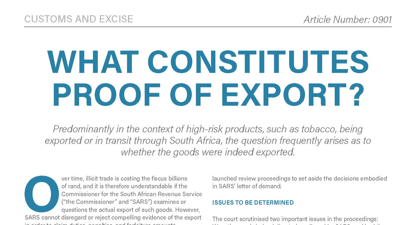
Predominantly in the context of high-risk products, such as tobacco, being exported or in transit through South Africa, the question frequently arises as to whether the goods were indeed exported. Over time, illicit trade is costing the fiscus billions of rand, and it is therefore understandable if the Commissioner for the South African Revenue Service (“the Commissioner” or “SARS”) examines or questions the actual export of such goods. However, SARS cannot disregard or reject compelling evidence of the export in order to claim duties, penalties, and forfeiture amounts.
Shepstone & Wylie (S&W) will not change its banking details. Any communication you receive stating we have done so will be false - please contact us immediately.
If you bank with Standard Bank, Nedbank, Investec, FNB or Absa Bank you are encouraged to pay us using the bank approved beneficiary: Shepstone and Wylie Attorneys.
If you don’t use the bank approved beneficiary option, you must always call us to verify our banking details before making any payment.